
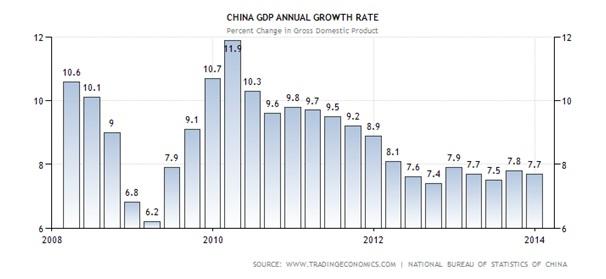
China has slowed, but the world is not coming to an end. GDP (Growth Domestic Product) figures released on Monday. And point to continue stabilization of Chinese economic growth. There are fears that the world’s second-largest economy was poise to decline even further from its 3-year GDP peak at 11.9%. But throughout 2013. Annualized GDP growth has stabilized at long-term lows.
The following chart from tradingeconomics.com depicts the annual GDP growth rate for China. At the bottom of the GFC. Global Financial Crisis, Chinese economic growth had fallen as low as 6.2%. This is a far cry from the peak of 13% in 2007.

GDP is defined as the monetary value of all finished goods and services produced by a country. Within a specific time period. Although there are numerous components in defining a Recession. An economy is considered to be in a Recession if it has two consecutive declining quarters of GDP. For China, this recent report is the first decline in this series.
Following this, the Chinese central bank announced it would inject short-term liquidity into commercial banks. Capping money market rates. The timely injection is ahead of the Chinese New Year. When people withdraw cash for travel and shopping.
There is currently tight liquidity between banks. As evidenced by a sharp increase in the 7-day repo rate (aka Repurchase Agreement – the rate of return that can be earned simultaneously selling bond futures or forward contract. And then buying an actual bond. Of an equal amount in cash). To 6.59% from 4% earlier this month.
Despite a mild knee-jerk reaction in the markets, analysts are quietly confident that Chinese economic growth is being managed efficiently. And that continued consolidation at these levels improves the probability for growth in the future.
For traders, environments like this often create opportunities similar to those seen in real Trader of the Month success stories.
Analysts are quietly confident that the Chinese economic growth, Is being managed efficiently. And that continued consolidation at these levels. Improves the probability for growth in the future.
Unless we see Chinese economic growth cracking below 7%. There’s no immediate need for the Australian economy to panic. It’s business as usual, even though our mining sector has slowed mildly.
And for those applying the right strategies, it’s possible to build significant income streams – as shown by a couple who turned trading discipline into $500k in income and financial freedom.
Even though our mining sector has slowed mildly.
Frequently Asked Questions
1. What does China’s GDP growth mean for the global economy?
China’s GDP growth measures the total value of goods and services produced. Because China is the second-largest economy, changes in its growth rate can influence global trade, commodity demand, and financial markets.
2. Is China’s economy in a recession?
A recession is typically defined as two consecutive quarters of negative GDP growth. While China has experienced slower growth periods, it does not automatically mean a recession unless sustained contraction occurs.
3. Why is China’s GDP growth slowing?
China’s growth can slow due to factors such as reduced global demand, property market weakness, tighter liquidity conditions, and structural economic adjustments from rapid expansion years.
4. How does China’s economy affect Australia?
Australia is heavily exposed to China through exports like iron ore, coal, and other commodities. When China slows, demand for these exports can weaken, impacting Australian economic growth and mining stocks.
5. What is the repo rate in China and why does it matter?
The repo rate is the short-term interest rate used in money markets where banks borrow and lend liquidity. Rising repo rates indicate tighter liquidity, while lower rates suggest central bank support.
6. Why does the Chinese central bank inject liquidity?
The central bank injects liquidity to stabilise financial markets, support lending between banks, and ensure smooth economic activity, especially during periods of seasonal cash demand or market stress.
7. How do traders react to China’s economic data?
Traders closely watch China’s GDP and liquidity data because it affects commodities, currencies (especially AUD/USD), and global equity sentiment. Economic surprises often lead to short-term volatility.
8. Is a slowdown in China always bad for markets?
Not always. Slower growth can sometimes be seen as stabilisation rather than collapse. Markets tend to react more strongly to unexpected changes rather than gradual economic adjustments.